
Crowd estimated at 150 attends city council meeting
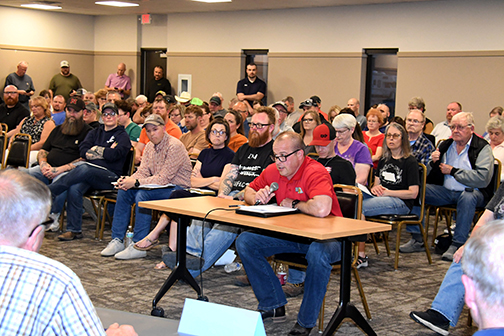
Of the estimated 150 people attending Tuesday’s Aurora City Council meeting, 20 stepped forward to share their opinions or raise questions about the city’s ambulance service and the council’s consideration of a plan to solicit proposals from private EMS providers. Some spoke in favor of considering proposals from private companies, some against, while others remained neutral, offering their own perspective on the issue during an hour-long public comment period.
Logan Bennett was the first at the microphone, urging the city to be cautious when considering private ambulance companies.
“I have worked in fire service in three difference states and I’ve experienced private EMS in all three of those states and I will say that I have never once seen the private EMS work on a community level,” Bennett said. “Every time it boils down to money over people, and in my time in fire service everything should be about the people. Private EMS is a private equity. It’s about growth. It’s about income. It’s about how much can we make off of the community and how little do we have to give back … I believe Aurora is too good a community to give up our fire-based service.”
William Feely offered a different perspective, but began with a message aimed directly at the EMS personnel in the room.
“I’m deeply grateful for their service and dedication,” Feely began. “I don’t make light of the fact that this decision may affect their jobs and the families of those employees. These are real people doing important work and any transition must be handled with care and respect for them.”
Feely shared that he has studied the six years of financial history of Aurora’s fire-based EMS, calling it a “money pit from Day 1.”
“The county commissioners made a wise decision to walk away from direct ambulance operations in 2017, based upon public acknowledgement that they did not have the knowledge or expertise to run EMS service,” he said. “The data is clear. City operation of the ambulance service with zero adjustments moving forward is fiscally unsound. The city of Aurora cannot withstand the economic trauma of funding ambulance services like we have since 2018. The city needs the opportunity to explore all options, either raising taxes on hard-working, already overtaxed citizens, contracting with a private vendor, allowing the ambulance service to run with strictly volunteer services, or more funding from the county. It’s time to be responsible, explore all your options and stop forcing Aurora families and businesses to subsidize hundreds of thousands in annual losses.”
Several speakers either currently serve on the Aurora ambulance crew, or have experience in the field.
“We’re all trained as firefighters,” noted Chris Hyde, a current member of the Aurora EMS crew. “We check all the trucks and do everything a firefighter would do and that service would be greatly diminished” if a private EMS provider is brought in. “And a lot of the staff don’t live here, but they’ve been here for a few years and they are very dedicated to this community.”
Hyde also noted that a private company would have no obligation to hire existing local staff members, which he said could cause some members of the crew, including himself, to consider looking for work elsewhere.
Gary Bruns of Lincoln, who attended the meeting on behalf of the Nebraska Professional Firefighters Association union, urged the council not to solicit bids from private EMS companies.
“Public, fire-based EMS is a core public safety service, not a convenience,” he said. “The system is proven efficient and trusted. Response times save lives. Fire departments are already located throughout our communities, so there are minimum delays, leveraging that infrastructure.
“The proposed change also brings major financial risk,” Bruns continued. “If Aurora and Hamilton County switch to a private EMS model there’s no guarantee of savings and the city still may need to fund dispatch, oversight, backup, response and coverage gaps. Private models often leave cities paying more than expected just to keep the system functioning.”
Bruns also announced that the Nebraska Department of Health and Human Services is now accepting applications for a rural health workforce incentive program, supporting EMS agencies with grants of up to $75,000 for providers who commit to serving in rural areas.
“Aurora and Hamilton County may be able to use this program to strengthen their recruitment and retention, keeping EMS local and sustainable,” he concluded. “A private, for-profit EMS system changes the mission.”
Dylan Christenson, who now serves as fire chief in Marquette, noted that Aurora is not the only community relying on the city’s fire-based ambulance services.
“If we lose a city-based, service-oriented EMS, that does not only affect the citizens of Aurora, but the entire county,” he said. “All of us outside communities rely on Aurora ambulance service to come provide medical services for us as well. I fear that if you go privatized, they will be off doing transports or anything else and we will be stuck to fend for ourselves with no additional help or services from anybody.”
Tanner Greenough, former director of the Aurora EMS who is still a member of the firefighters union working in Grand Island, noted that the number of transfer calls has decreased since he left, though the number of staff members increased from 12 to 15.
“We ran 474 transfers in 2021-22 and last year they ran 364,” Greenough said. “Simple math, that’s 100 transfers less with three more people. So my hard question is why?”
“I also think this committee (Aurora City Council) has been vilified a little bit on social media,” Greenough added. “I’m in the union and I understand the tactics, but I wanted to personally thank you for taking a look at all options and volunteering your time. This isn’t your full-time job. You are volunteering to do so, so thank you.”
Candidates speak out
Two people seeking a seat at City Hall also shared their perspectives during the meeting. Harlan Schafer, who served for many years on both the city council and Aurora Fire Department, is now running unopposed to be elected as mayor.
“With regard to the requests for proposals, the citizens of Aurora need to know, they deserve to know, if there is a workable, practical approach to providing EMS, other than what we’re doing now,” Schafer said. “I don’t understand why anyone would resist allowing the community to look at that. What are we afraid of? So in that, I feel the city has a right to know. The citizens have a right to know. I would expect the council to unanimously authorize this request for proposals.”
Jannelle Seim, who is running unopposed for a Ward 1 seat on the council, is one of several local citizens serving on a committee to review the city’s finances. She said she wanted to talk about the numbers, noting that the expense for running the ambulance service went from $944,000 in 2019 to $1.9 million last year.
“That’s a million dollars that we have increased expenses,” she said. “This group got together to say where can we cut? What can we do? Do we need 15 (EMS staff members)? Can we do it with 12? Can we do it with nine? Can we do it with six? The reason we looked at six and nine is when you have $1.8 million in operating funds and your revenue is $1 million … it’s not sustainable.
“We can get rid of the pool, get rid of the library and get rid of the police force and it’s still not covering the deficit,” Seim continued. “We can raise the taxes. We can get a sales tax. It’s not enough to sustain it as it is, so I don’t think anyone in this room is saying get rid of ALS, the advanced level of care, or go to volunteer, but I think we need to right-size it for the community based on the call volume that we have. If our call volume has gone down from 1,166 when we had 12 to 1,049, why do we need three extra people? I’m not saying fire everybody. I’m a big fan of attrition, but if you can do it with a smaller amount of staff and still maintain the 911 service that we have, then that’s what we should be looking at. I think the RFP is a piece of the puzzle that we need to take a look at before we make any decisions.”