
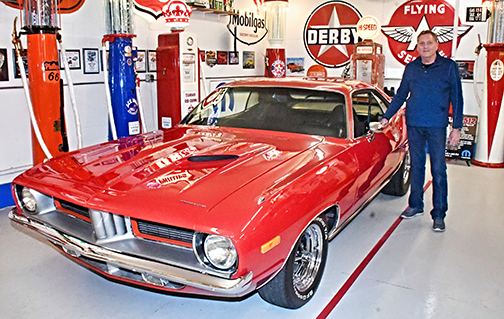
Our annual spring car care section is here in this week's issue of ANR. In addition to articles to help readers learn how to better care for their automobiles, they will find the story of Mike Bish and his restoration of a classic 1971 Plymouth Cuda, one of the last of the late 60s and early 70s American muscle cars.
If a person was to visit Mike Bish at his personal hot rod garage in Grand Island and ask to see the ‘71 Plymouth Cuda he’s currently restoring, he might tell you “Well, it’s over there... and over there and over here in this box, but the bigger parts are at Wiarda Rod & Custom in Hampton getting painted.”
Bish, a native of Giltner, currently has three completed vintage muscle cars in his shop and hopes to have the fourth – the Cuda – there within the next few months. However, he has a lot of work ahead of him before he’s ready to put it on display at an area car show.
Most people who know anything about late 1960s to early ‘70s American muscle cars know about the Barracuda, manufactured by Chrysler from 1964 to ‘74. But within the Barracuda family, there was a special sub-species that stood out for its exceptional performance and power: the Cuda. Developed as a high-performance version of the Barracuda, the Cuda was designed to satisfy those who were looking for big engines, power and speed on the open road. Bish says the Cuda was one of his dream cars when he was in high school in the 70s and his lifelong love for cars was in its infancy. “We started building stock cars, so that’s kind of where this all came from,” he said. “Rick Hunnicutt, who is still in the racing in Giltner, and I got together when we were freshmen and sophomores in high school and started building stock cars. And so that kind of drove my love for cars, and then in about 2001 is when I got my ‘69 Camaro (one of the cars in his shop). That was kind of my first hot rod.”
Last of the muscle cars
Bish said he is often asked, “Are these the cars you had in high school?” “No,” he tells them, “These are the cars the older kids had that I wanted but couldn’t afford.” Bish says he always wanted a Cuda because they were one of the last of a breed that died out in the early 70s with the energy crisis, when Americans were told the world was running out of oil. He says 1971 was really the last year of the true muscle car.
“They started taking all the big motors out, putting smaller motors in for fuel mileage and insurance purposes,” he said. “Insurance was getting way too high, and people couldn’t afford insurance or the gas, so they started putting smaller motors in them. And that’s when they started selling the Pintos and Vegas and those kind of things.”
Bish says the car had less than 70,000 actual miles on it when he bought it from someone in Aurora about three years ago. He said the car was covered in dust after having been stored in a hanger at the airport for several years, but the previous owner had started to work on restoration so more than $6,000 worth of parts came with it. Having started its life on the East Coast where it was owned by someone in the Air Force, Bish said the Cuda made its way to Texas and then back to Pennsylvania before eventually landing in Aurora.
Having brought the car home essentially in one piece, the first thing Bish did was start tearing it apart so that each part could be gone through and restored. The entire interior was removed as well as the grill, rear end, suspension and engine. The body was then sent on casters to the Wiarda brothers for body work and painting in its original Mopar color of “Glacial Blue.” Because it spent its early years near the ocean, Bish said the car was rusting from the top down so the roof and trunk floor had to be replaced, as well as one of the quarter panels which had gotten bumped in a collision.
The 383 Mopar powerplant was sent off to a shop in Waco to be entirely gone through. When he got it back, Bish painted it and put the various components back on it. It now waits on an engine stand in his shop to be reunited with the body. Bish said only 501 cars were built with that engine paired with a 4-speed transmission in 1971.
The dash, steering column, seats and other interior parts went to other shops and they, along with all the other new and refurbished parts, are now back in Bish’s garage waiting to be reinstalled.
One of the more interesting options of the ‘71 Cuda is among the items now sitting in Bish’s shop. It’s a blue vinyl-covered cassette player, one of the earliest ones to be installed in automobiles. What’s more, it is able to record using a microphone which Bish has in its original cardboard box from the manufacturer.
Reuniting the parts
“Hopefully the plan is to get it back here in the next couple three months,” Bish said referring to the Cuda’s body. “They’ve got to sand it and buff it after it’s painted to make the paint just perfect. And then they’ll put the big decals on the quarter panel. It’s called a ‘billboard decal.’ That was ‘71, the only year they did that.”
In addition to the three other cars currently in his collection – a red ‘74 Cuda, a ‘69 Camaro and a yellow ‘70 Chevelle SS – Bish also has on display in his shop a number of automotive signs and a large collection of gas pumps, some dating back to the 1920s.
When the Cuda is put back together and ready for the open road, car enthusiasts won’t need an invitation to Bish’s garage to see the vehicle. He plans to take it on the road to car shows around the area just like he regularly does with his other cars, which he usually drives to shows in places like Giltner and Hampton.
“I do a lot of car shows now, with my three I have,” he said “I’ll maybe trailer it in the beginning, because it’s going to be so nice but I’m planning on driving it, too. I drive all my cars. I don’t ever trailer any of them. I like go to car shows all around central part of Nebraska. What’s the point if you don’t drive them, right? And that’s kind of why I like car shows so I can drive them. Otherwise you really have no reason to drive them other than just take them out. But you really don’t want to be driving around downtown Grand Island and have somebody run into you, so I just get them out on the highway, because that’s kind of what they’re good for, right?”
Bish said he’s glad to have the support of his wife, Susie, who retired last year after 17 years of teaching with the Aurora School District.
“She’s kind of involved in helping out,” he said. “She likes it too. She’s very proud of it.”
Having restored and sold a black and gold “Smokey and the Bandit” Trans Am and various other muscle cars, and with the soon completion of his “dream car” Cuda, Bish said he thinks he’s done building hot rods.
“I’d love to have a ‘69 Charger,” he said. “A friend of mine from Hastings has one – HEMI orange, black vinyl roof – so that definitely would be the only car probably that I would do another restoration if I could find the right ‘69 Charger. But otherwise, I’m done... I hope.”