
5 noxious weeds, several invasive species a problem in Hamilton County
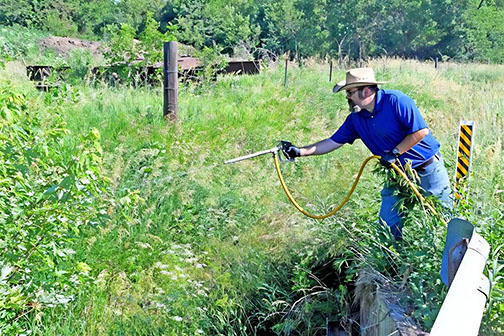
Thanks to caring landowners and the vigilance of county road crews and many others, Hamilton County is in pretty good shape in terms of its noxious weed situation. That was the report from county highway department superintendent and weed superintendent Jeremy Brandt to the county commission late last month. In his annual state-mandated report to the commission, Brandt discussed how he handles his responsibility as part-time weed superintendent and the help he receives from county residents, various state agencies and organizations and members of the public in tackling noxious weeds and invasive species in the county.
In an interview following the Jan. 27 meeting with the board, Brandt gave an overview of his presentation.
“I talked with the commissioners and explained our process of how we do our inspections,” Brandt said. “Most of it is based on random inspections, just driving down the road and just picking points. I also go back to wherever we had weed notifications from the prior year, and I use those locations to start with. And then we also go based off of anybody calling the office and saying ‘Hey, I see weeds over here. You might want to go look at this pasture...’ And then I went through the control plan, which is talking about if we have to do any type of enforcement outside of official notices to get a landowner to control their weeds, then we have the 10 day and the 15 day notices that we can utilize to force control.”
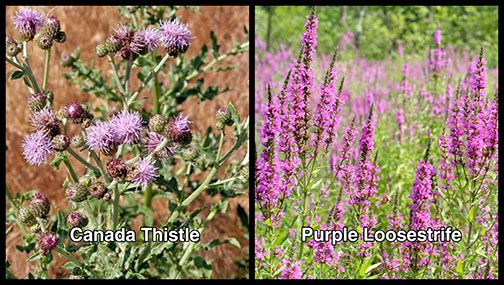
Brandt said there are five noxious weeds prevalent in the county, including Canada thistle, musk thistle, phragmites (also known as common reed), purple loosestrife and leafy spurge.
He said of those, Canada thistle, which is known by its spiky purple blossom, seems to have made a big comeback last season in the county.
“This last year of ‘24 we’ve seen a big explosion of Canada thistle in the roadsides,” he said. “In doing further research I learned those seeds can actually stay viable in the soil for 30 to 40 years, so those could have been really bad two decades ago, and then it sat there idle this whole time, and just conditions were right as far as moisture, and then boom, here they were.”
He said the phragmites and purple loosestrife, which thrive in wet areas, tend to be mostly found along the river on the west and north ends of the county,
Brandt said of the five noxious weeds commonly found here, leafy spurge is the least prevalent but the hardest to eradicate of them all.
“We have one little, tiny spot in the county, a mile off the interstate, and there’s probably a half a mile long,” he said. “We’ve kept it at bay, it’s about half the size it was six years ago. That’s probably one of the toughest ones to control, but we’ve been able to keep that at bay, and it’s 90 percent in the road ditch. It’s not even out in the pasture fields, so that’s a blessing. It’ll have a tap root that can, I believe, go eight to 10 feet deep, and it’s a very prolific seed producer, so it can get away very quickly if it’s not maintained.”
Noxious thistle look-alikes
Brandt said in addition to his regular patrols of the county to check problem areas, calls from the public also help identify infestations of certain weeds, however, sometimes it’s a false alarm.
“A lot of people call in after the noxious thistle season, and it’s late summer, early fall, and the thistles that are popping up are all natives so there’s nothing we can do about those,” he said.
According to Brandt, the noxious Canada and musk thistles are usually done dropping their seeds by July, but that’s when the native Platte, tall and prairie thistles start to bloom. He said that’s often when the calls will start to roll into his office.
“So we get through the noxious weed season, and then all these other thistles will start popping up, which they are everywhere,” he said. “They’re in ditches and pastures, and people start seeing those, and they think that things are getting out of control. So they’ll start calling in. But they come later in the summer, but most of them still have purple flowers or white flowers, just like noxious ones. But most typically, they’re smaller and they’re not as prolific at seed production. Like a musk thistle, if you let that go for a couple seasons, it’ll be twice the size of this room, and a tall or a Platte thistle will drop its head, and possibly 10 percent of those seeds will actually produce and so they just don’t get out of control. Plus, they’ve been here for hundreds of years. They’re native here. They weren’t brought in.”
According to Brandt, most of the noxious thistles came from Eurasia many years ago and were imported as ornamental plants or the seeds were brought in with commercial bird seed.
In addition to people reporting possible thistle infestations, Brandt said many calls come from the northwestern parts of the county along the Platte River.
“A lot of the owners of lakeside homes up there will call because phragmites are always coming into their ponds and on their properties and so we help them try to take care of those issues,” he said. But that’s the other thing that kind of helps us out. Since the county is a member county of the Platte Valley Weed Management Association – there’s 13 counties and we work together – our county actually benefits by being a part of that because they spend roughly $30,000 a year helping us with noxious weed control along the river in the flood plain areas up in the northern part of the county, whether it be helicopter, drone, air boat, and then we can also utilize chemicals through that agency as well.”
Part-time job, full-time vigilance
Brandt has been serving as the part-time weed superintendent for the county for the past six years – as long as he has been with the county. He first served as county planning and zoning director and has been the highway superintendent the past several years. Previously the county employed a full-time weed superintendent, but Brandt said the part time situation has worked out well for the county and saved tax dollars.
“I would say it’s getting to be the norm (in Nebraska) nowadays to have a part time weed superintendent that is also overseeing another department,” he said. “A lot of it has to do with county budgets. You know, we want to keep the tax levy down so everybody’s always got to try to figure out places to stay within their budget, and the weed department seems to be one of the first ones that kind of gets cramped down. A full time weed department is very expensive. Right now I average probably $2,000 to $3,000 in herbicide costs a year. And if we were full-time spraying every ditch and cutting every tree, we would clearly be $30,000 to $50,000 for chemical costs alone. Plus you’d have to have more manpower to be able to spray.”
Brandt said the time and cost to spray the ditches of the more than a thousand miles of county roads would be astronomical.
While he does spray problem areas in county road ditches, Brandt said these days the job is mostly enforcement of the rules that pertain to noxious weeds.
“The main focus right now is just basically enforcement, which is doing random inspections across the county, looking to see if we can find anything, and then following up on issues that we find or that have been turned into our office,” he said. “And then if we have an issue our initial step is to send out an official notice to them that their field was inspected and that a noxious weed was found. I also provide recommendations on how to take care of that, whether it’s best to take care of it in the spring or the fall, and maybe a follow up in the fall to hit it again. And then we wait about two weeks, we go back out and double check to see if anything’s been taken care of. And then if nothing was done at that point, then we can go to the next level of enforcement, which is a 10- or 15-day notice, which then the county would have to go in and force control if the landowner does not comply, and then the landowner will get billed via a lien being placed on their property, so then they would have to pay the county back on top of their taxes for that property.”
Brandt said in more than six years in the position he has never yet had to issue a 10- or 15-day notice to a landowner. However, he did note that sometimes getting the notice to the actual owner of the property can be a problem and frustrates renters.
“That’s something that many people really don’t know, is that if we do find an issue, we have to contact the landowner, and we have a lot of absent landowners in this county,” he said. “It frustrates renters sometimes, because I can’t go talk to you because you’re renting it. I have to contact your landlord, because that’s who’s responsible for the weeds on the property. So, yeah, that can be kind of tricky some days.”
Brandt said he also works to battle several invasive species of plants that are found here, including Queen Anne’s Lace, poison hemlock, garlic mustard and common cinquefoil.
Biological controls
In addition to using conventional measures, such as herbicides to go after noxious weeds, Brandt said the county and cooperating agencies are also looking into biological controls.
“So the NWCA, which is the Nebraska Weed Control Association – all 93 counties are a part of that – we actually have a biocontrol person that works with us, and he has started going to a lot of seminars and conferences around the country. And so we are actually starting to bring in more and more biocontrols to Nebraska that are allowed here. Three years ago I released Canada thistle rust (a fungus that attacks only the Canada thistle), which came from Colorado. We are one of 10 sites testing it and we actually have two sites in Hamilton County right now, so that could end up being a pretty big deal, especially with the organic farming that we have happening. So we are trying to look more at biocontrols if we can do it right now there’s a moth that we’re trying to get access to out of North Dakota, and its job is to minimize and eliminate poison hemlock. And so we’re actually looking at trying to get that biocontrol and see if we can get it in Nebraska. So we’re looking a lot more of that to try to see if we can minimize the herbicides that we’re utilizing.”
Noting that the county has “a lot of caring landowners,” Brandt concluded, “I think Hamilton County is actually in pretty good shape. Of course, along the river will be a never ending battle. As long as the water flows, we’re always going to have things moving along there, but just as long as the public continues to help us and landowners are managing their properties, I think we’re doing pretty good.”
Brandt urged those who are interested in the subject to be on the lookout for the spring edition of “Weed Watch,” which is published semi-annually by the Nebraska Weed Management Coalition.